
Active Warrants in Fulton County
There is no public list you can search by name. Fulton County keeps warrant information inside the Sheriff's Office GCIC and Warrant Unit operations. Its rule: the subject must come in person with photo ID to the courthouse or jail. Nothing is confirmed by phone. The Most Wanted page is a selected program, not an inventory. Active and outstanding just mean an order remains open in the controlling court or law-enforcement system. The label alone never tells you whether the case is a felony, misdemeanor, probation matter, traffic FTA, or city ordinance issue. Whoever issued it, and why, points you to the right route in Fulton County.
Fulton County Active Warrants Have No Full List
The Sheriff's Field Operations instructions govern the process. You can call 404-612-5129 for routing. Do not expect warrant status by phone. The person being checked must appear at the Fulton County Courthouse or Fulton County Jail and show proper photo identification. That visit is the verification step. An open-records request is something different. It may return an existing returned warrant, disposition, or processing record if that record is public, but it is not a live warrant confirmation service.
How the Fulton County Active Warrant List Works
The sheriff's only publication is Most Wanted Fugitives. That page can show descriptors, a warrant number, offenses, agency, status, and possible reward for selected cases. There are no name-search fields. Superior, State, Magistrate, and municipal courts each keep separate case records, so no single Fulton County page compiles every source.
Note: Publication and court updates can lag service or recall, so a missing name does not prove no warrant exists and a listed entry still requires confirmation.
Fulton County Active Warrant Workload
The Fulton County Marshal warrant page covers one lane of local service. The Sheriff's Office reports that its Warrant Unit receives more than 21,000 criminal warrants each year. That figure is annual intake. It is not a count of current outstanding warrants, so reading it as a live backlog would overstate what the number proves.
Volume explains the split. A court record, a service record, and current warrant status can sit in different Fulton County systems, so precise identifiers are worth having when you contact the issuing office.
What a Fulton County Active Warrant Shows
Fields vary by source. The issuer and the status matter most, since they identify who can change the order. Fulton County warrant numbers carry year, court, or FTA-style segments that differ case to case, so no example proves a universal format.
| Warrant Number | An agency or court identifier, sometimes with year or FTA markers, such as 2026-FTA-#### as a nonofficial sample. |
|---|---|
| Charge or Offense | The allegation, probation issue, failure to appear, or court-order violation. |
| Issuing Court | Superior, State, Magistrate, or the municipal court controlling the case. |
| Bond Information | An amount, bond type, appearance requirement, or no-bond direction when disclosable. |
| Status | Active or outstanding until service, return, recall, quash, or another court-cleared event. |
Fulton County Active Warrants Split by Court
Superior Court of Fulton County takes the felonies. State Court handles county misdemeanors, traffic, probation matters, and related FTA proceedings. Magistrate Court handles warrant applications and first appearances. Municipal courts run their own city citation and bench-warrant dockets. The Fulton County Marshal mainly executes Magistrate-originated criminal warrants and State Court misdemeanor-probation warrants. So a city FTA can be active yet absent from the sheriff's curated program. Atlanta offers Find My Case and FTA Court. Sandy Springs permits FTA and bench-warrant walk-ins. South Fulton uses a court calendar, JusticeONE, and a Court Date Request Form, while Roswell and Johns Creek direct people with missed dates to Court Services. Start with the paperwork or citation, then confirm with that court.
Most-Wanted Lists and Warrant Roundups
The Fulton County Sheriff's Office runs a curated Most Wanted Fugitives program. Tips go through Crime Stoppers Atlanta and P3. That page is not the full active-warrant inventory. Fulton's municipal programs can address limited warrant groups as well. Atlanta held a traffic-only amnesty period in 2025, and South Fulton held an Amnesty Week in 2025, but neither past event should be treated as active in 2026.
Key Point: The official Fulton Most Wanted program publishes selected cases and tip instructions, not a complete roster of Fulton County active warrants.
Do not approach a listed person. Use the official tip channel, and confirm personal warrant status through the issuing court and approved sheriff route.
Most Wanted entries change often. View the official Fulton County program page at its source for current listings and reward details.
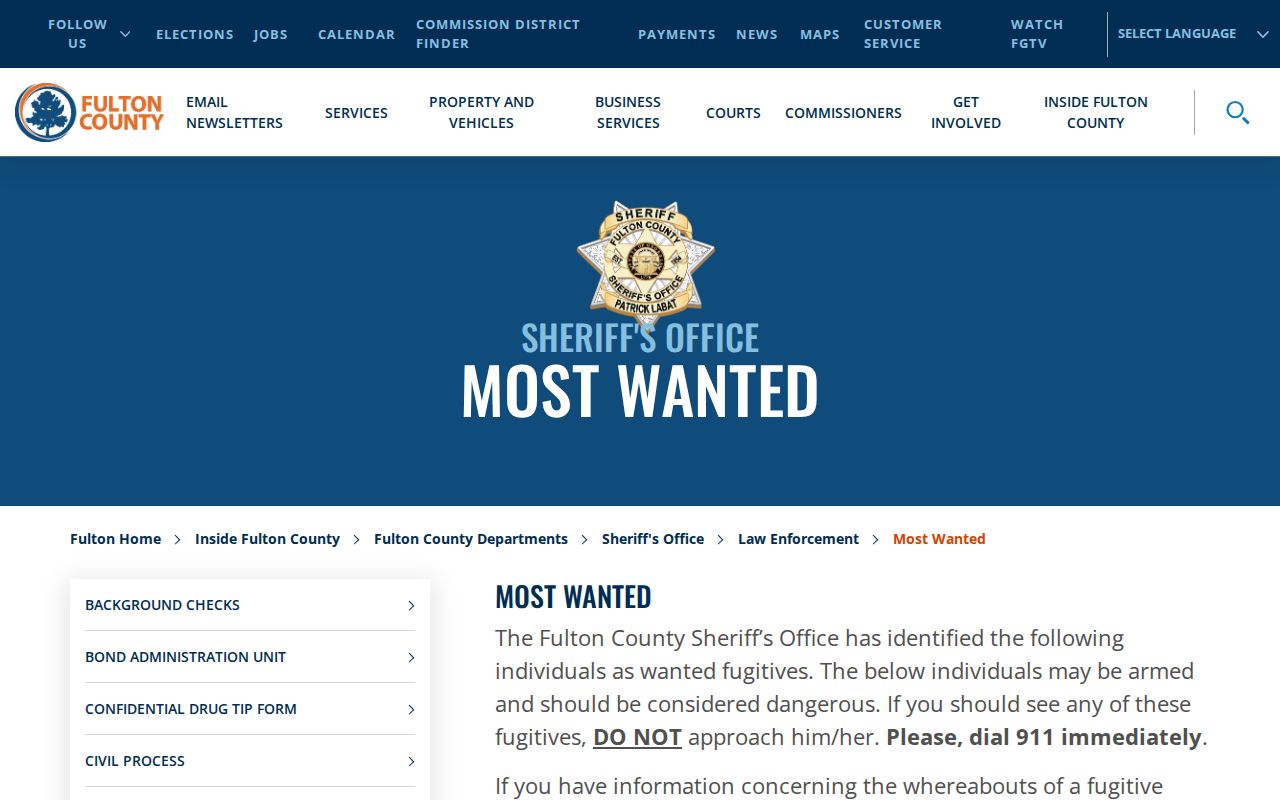
The Fulton County program page pairs its header with a Crime Stoppers tip banner rather than any individual profile.
Fulton County Warrant Status Needs Proof
Serving a warrant is not the end of the story. In Fulton County, an arrest, a recall, and the closing of a case are three separate events. Officers may serve a warrant and hand it back to the issuing court. A judge can then recall or quash it after an appearance, a reset, a payment, or a motion. Even then, the underlying charge may stay open, so a cleared arrest command does not close the case itself.
Keep your paper trail. That means a signed recall or quash order, any bond papers, receipts, and the final disposition. If the case began as a traffic failure to appear, hold onto proof that the court sent its release to Georgia DDS. Do not trust an old copy from a third-party site either. The controlling docket is what counts, so verify it with the clerk before you act on anything else.
Fulton County records also move between the court and service systems on their own schedules. A warrant may show one status in one system and another elsewhere. A fresh confirmation from the clerk gives you the context an older list entry lacks. It also points you to the next court step, whatever that turns out to be.
Confirming Fulton County Active Warrants
Start with the issuing court. The clerk can pull the docket and tell you whether a Fulton County order is active, served, returned, recalled, or quashed. Sheriff verification follows an in-person photo-ID rule. The subject must appear in person. The Warrant Unit phone line can help with routing. It cannot provide status. Helping a family member has limits, because the sheriff restricts confirmation to the subject alone. A lawyer has more room. Counsel can contact the court, request available records, and plan the next step without treating any public page as complete. For Magistrate-originated criminal warrants or State Court misdemeanor-probation service, the Fulton County Marshal's documented warrant lane may also matter. Statewide options are thin. Georgia's GCIC is closed to public lookup. DDS only reports the license consequence of a traffic FTA. A Georgia Open Records request can seek an existing nonexempt processing record, returned warrant, or disposition from the likely custodian. It cannot create a live statewide list or compel release of sealed, juvenile, or active-investigation material.
If Your Name Is on the Fulton Warrant List
Don't treat a web entry as complete instructions. A lawyer can contact the issuing court, weigh whether voluntary surrender fits, and ask if the matter is bondable or open to a motion to recall or quash. A municipal FTA might use a court reset, an eligible payment, or a judge appearance instead. Bond options vary too. Fulton County lists cash, property, and authorized professional bonds. Availability and amount still depend on the charge and the court.
Important: Consult a lawyer before appearing or surrendering; an active warrant can lead to arrest during a traffic stop or other law-enforcement contact.