
The Fulton County Most Wanted Program
Fulton County's Most Wanted Fugitives page is a public-safety and tip program run by the Sheriff's Office. It pulls selected cases into wider view and steers the public toward Crime Stoppers Greater Atlanta and the P3 Tips system. What it is not: a court docket, a full warrant search, or a roster of every person with an unserved warrant in Fulton County. Most active warrants never get a card. For current details, use the official Fulton County Sheriff program. Names, images, mugshots, addresses, and card entries belong on the agency's own page, which is where corrections and status changes land first. Stale copies spread when a warrant is served or recalled and nobody updates the mirror.
Official Fulton County Program Link
The Fulton County Sheriff's page carries the agency heading, program instructions, tip routes, and safety warnings. Only that program-level material appears in the manifest. No profile, photo, or private person is shown.
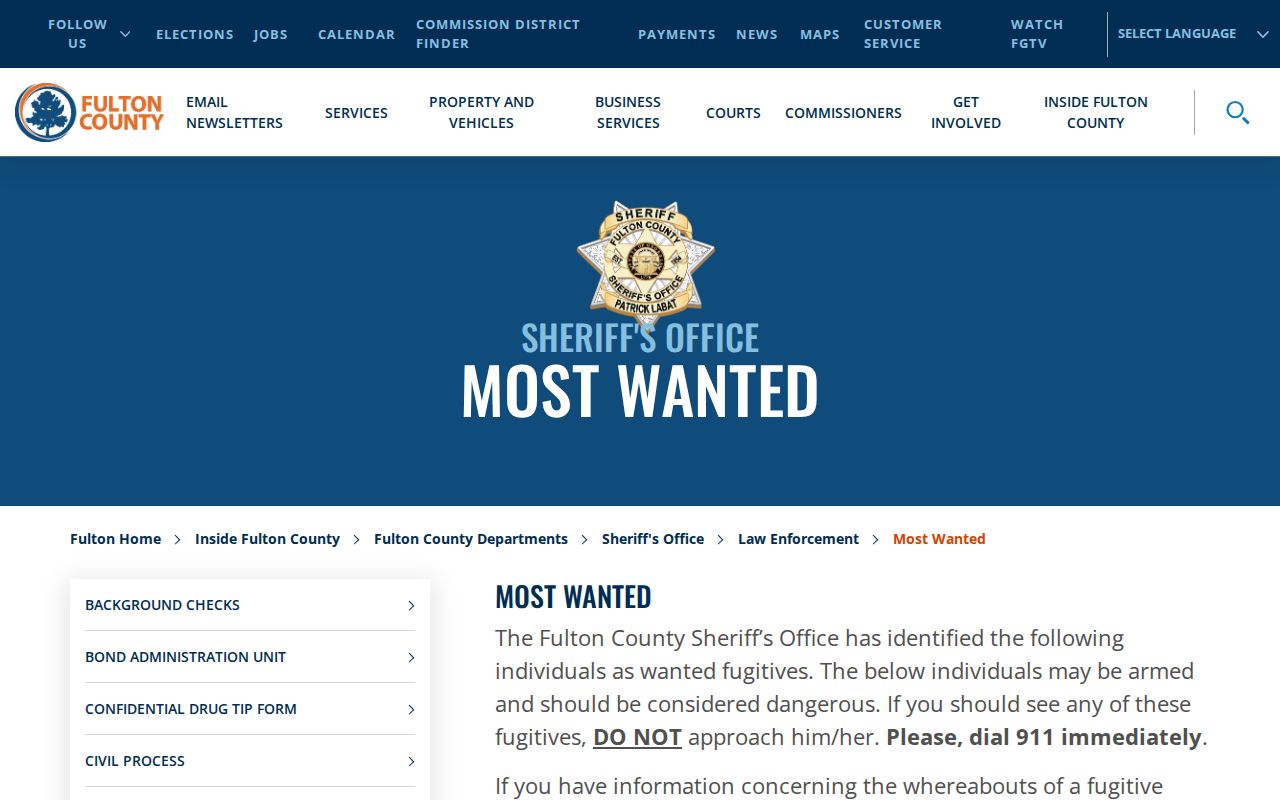
The live most-wanted roster stays under the Fulton County Sheriff's control, which is exactly where it belongs. Any correction the Sheriff makes after publication shows up there right away. The page carries no single global timestamp for the whole list, so treat it as a current agency posting that can still lag behind an arrest, a surrender, or a judicial recall. An old copy saved from the page proves nothing about present status. Go back to the source each time you need to know where a Fulton County warrant stands.
How the Lists Work
A most-wanted program is selective by design. The agency picks a subset of open warrants that match its priorities and investigative needs. A Fulton County card can carry a name, photograph, aliases, birth date, physical descriptors, charge, last known address, warning text, and reward language. That is public-interface material, nothing more, and none of it is republished here. People drop off the list after an arrest, a surrender, a warrant recall, or routine agency review. Fulton County publishes no promised update schedule for the whole program, so a card set can change between visits. Absence cuts the other way too. A blank result means only that no current card is visible. It does not prove that Superior, State, Magistrate, or a municipal court holds no active order against a person.
Note: The Fulton County most wanted list is a changing curated snapshot, not a complete active-warrant database or court record.
Fulton County Card Fields Explained
A program card runs far shorter than a court file. Fulton County gives the public just enough to recognize a subject and send a tip. The issuing judge, full docket, bond, service history, and later court action may all be missing.
- Alias
- Another name the agency associates with its listing.
- Charge
- The alleged offense connected to the priority warrant, not a judgment of guilt.
- Last known address
- Historical agency information, not proof of a current location.
- Reward language
- A notice that an eligible anonymous tip may qualify under program terms.
- Status change
- Arrest, surrender, recall, or review that may cause a listing to change.
No card replaces the signed warrant or the criminal docket. Legal status belongs to the issuing court. The Fulton County Sheriff controls only its own program page.
How to Report a Tip Safely
Crime Stoppers Greater Atlanta takes anonymous tips at 404-577-TIPS, which is 404-577-8477. The Fulton County Sheriff's page also points to the P3 Tips mobile app and an online tip route. Call 911 for an emergency or a crime in progress. Never confront, follow, detain, or photograph anyone.
- Move to a safe place and avoid direct contact.
- Use the official Crime Stoppers number, P3 app, or linked form.
- Give the location, time, direction of travel, and other useful facts.
- Keep the tip identifier if the system supplies one.
- Let trained law-enforcement officers decide how to respond.
Tips may qualify for a reward under program rules. Crime Stoppers alone controls eligibility and payment. Skip any social account posing as official, and pay no one who claims a fee is required.
Safety first: Report facts through Crime Stoppers or 911, then step away. Do not pursue or attempt an arrest.
Crime Stoppers and P3 Tips
Fulton County's program opens more than one authorized tip channel. Use the Crime Stoppers line by phone. Use the P3 Tips app on a phone, or the online route the official program supplies. Each channel exists to take information without turning the caller into an investigator. A good report sticks to firsthand observations. Give a precise place, time, vehicle description, and direction of travel if you know them. Guesses about identity, motive, or guilt help no one. The warrant and program card already carry the agency's case context; your job is only what you saw. Reward wording is conditional, too. It promises no payment for every submission and authorizes no one to confront a person. Keep any claim number private, and route follow-up questions through the same official Crime Stoppers channel.
Most Wanted vs an Active Warrant
Every most-wanted listing reflects an agency's priorities, yet most active warrants never get that treatment. Fulton County offers no online full-name public warrant search. Per the Sheriff, warrant status is subject-only and in person with photo ID at the courthouse or jail. Phone requests do not work.
| Feature | Most Wanted Program | Active Warrant |
|---|---|---|
| Scope | Selected priority cases | Any unserved enforceable order |
| Public source | Sheriff program page | Issuing court and lawful agency channels |
| Information | Short recognition and tip card | Warrant instrument, docket, status, bond |
| Confirmation | Current official program link | Subject-only Sheriff process and issuing court |
| Resolution | Arrest, surrender, or warrant change | Service, surrender, recall, or quash |
For the larger category, see Fulton County active warrants. Never use the published program as a negative-search certificate.
Fulton County GCIC Context
The Fulton County Sheriff's GCIC Unit verifies criminal warrants and enters eligible records into GCIC and NCIC. Those are criminal-justice systems, not public websites. Georgia runs no single statewide public warrant portal. The Most Wanted page draws eyes to chosen cases; the operational systems serve authorized agencies.
The 404-612-5129 figure coming out of the Warrant Unit tracks yearly intake, not live totals. Warrants in Fulton County get served, recalled, and returned all year long. So that number can't estimate how many active warrants exist today, or how long the Most Wanted list runs. One more limit matters here. The unit's rule bars confirming warrant status over the phone, so a call gets you process information only.
Fulton County Fugitive Partners
Serving a warrant in Fulton County can pull in several agencies at once. The Fulton Sheriff runs its own warrant and GCIC functions. The Fulton Marshal handles warrants that come out of Magistrate Court, plus State Court misdemeanor probation matters. City police work their local cases. For federal or cross-jurisdiction fugitive work, the U.S. Marshals Service and the Southeast Regional Fugitive Task Force may step in. None of this expands what the public can see. A city failure to appear may never show on the Sheriff's Most Wanted page, a sealed federal warrant may stay out of PACER until it is served, and a Marshal assignment can reflect the issuing court rather than any choice to give public notice. So match your tip to the right channel. An immediate threat goes to 911. A non-emergency tip about an official Fulton listing belongs with Crime Stoppers or P3. If the worry is your own possible warrant, skip the tip line and talk to a lawyer and the proper court instead.
If You Believe You Are on a List
Skip the cached copy, the saved image, and any third-party repost if you believe you are listed. Have a Georgia criminal-defense attorney pull up the current official source, identify the issuing court, and confirm the case through lawful channels. Counsel can also walk you through voluntary surrender, bond preparation, and whether a motion to recall or quash the warrant is on the table. Direct Sheriff confirmation is limited: the subject must appear in person with proper photo identification at the Fulton County Courthouse or the Fulton County Jail, and staff give status only to that person. Since showing up can mean service of an active warrant, get legal advice first. The phone line does not confirm status.
Important: Do not approach law enforcement without a plan. Counsel can confirm the warrant and coordinate a lawful surrender and bond.
After any court action, get a signed recall, disposition, or written release. Coming off a public list in Fulton County does not by itself prove the case ended.
Fulton County Listing Limits
A most-wanted card is not a case file. It may leave out bond information, the judge, a full event history, later filings, and a clear update date for the whole list. The official page also cannot tell you whether someone with no card has a municipal FTA, a State Court warrant, a sealed warrant, or a Magistrate-originated order. For deeper records, the Georgia Open Records Act, O.C.G.A. § 50-18-70 et seq., lets you request existing public agency records, though fees and exemptions apply. It cannot force open sealed, juvenile, or protected investigative data, and a request is not real-time confirmation. Court records sit with the court or clerk that holds them. The rule in Fulton County is simple: send tips through the official program link, and take legal status questions to the issuing court. A most-wanted page is public notice. It is no substitute for a warrant, a docket, a recall order, or a final disposition.