
How to Search for a Warrant in Fulton County
There is no public Fulton-wide or Georgia-wide name search for all warrants. The Fulton County Sheriff's Office Field Operations page says staff will not provide warrant status by phone. Status is given only to the subject, in person, with proper photo identification at the Fulton County Courthouse or Fulton County Jail. The Warrant Unit number, 404-612-5129, is useful for routing questions, not phone confirmation.
Before starting, gather the subject's own full legal name, date of birth, case or citation number, likely court, and any court papers. A lawyer can advise on safe appearance, surrender, bond, or recall before the subject acts on a possible match.
- Identify Superior, State, Magistrate, or a municipal court as the likely issuer from the charge, citation, or paperwork.
- Use that court's official case route, then ask the clerk for the case status, issuing judge, and office that controls recall.
- For sheriff-held status, the subject should plan an in-person photo-ID check at the courthouse or jail and call the Warrant Unit only for directions.
- Request an existing nonexempt record from the sheriff or clerk when a docket, returned warrant, or disposition is needed.
- Confirm the result with the issuing court. GCIC is for criminal-justice agencies, and DDS reports traffic-license consequences, not a public statewide warrant result.
Fulton Warrant Unit Verification
Fulton's subject-only rule changes the normal idea of an online warrant lookup. A person cannot use the Warrant Unit phone number to receive a yes-or-no status. The subject must appear at the sheriff's courthouse or jail location with proper photo ID. That protects sensitive information but requires more planning than a web form.
The official Field Operations page shows the Warrant Unit and GCIC role. Its published warrant-status instructions can be reviewed before traveling.
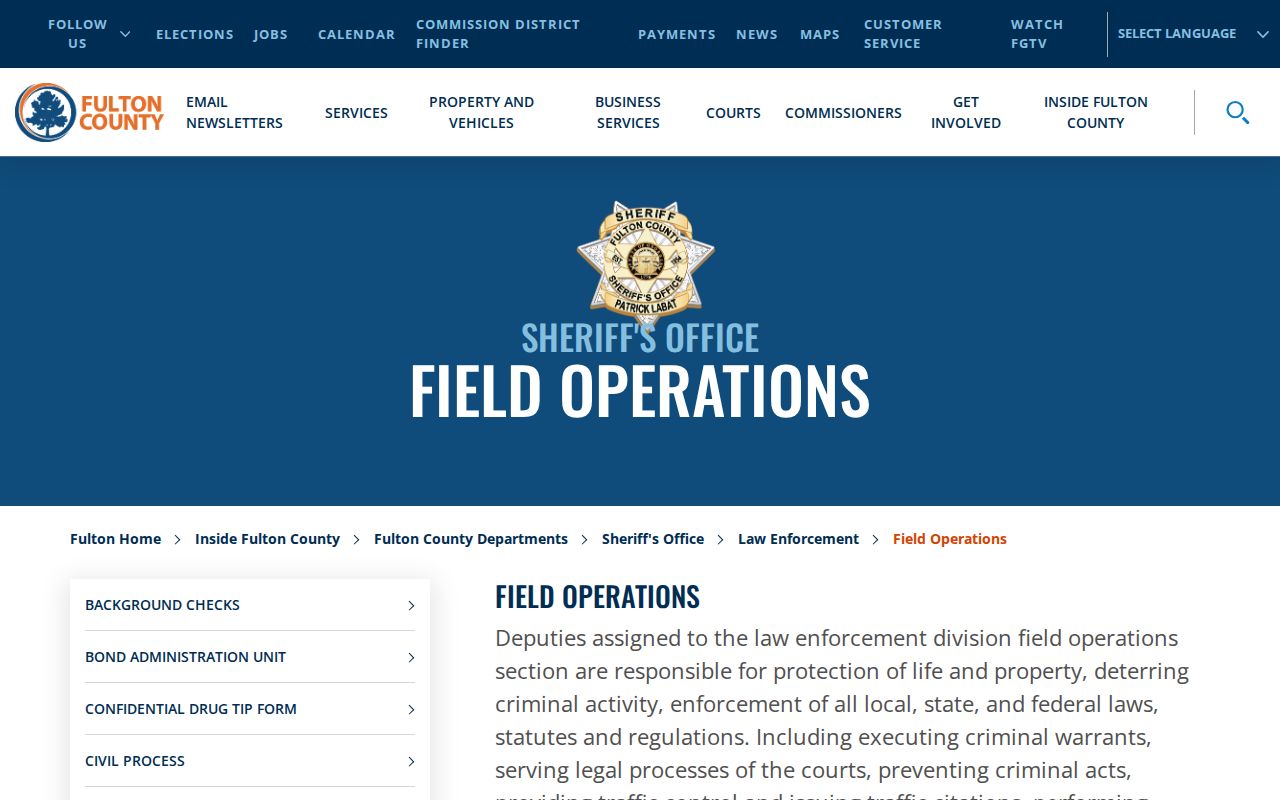
The image reinforces the key local limit: the phone channel routes callers, while the subject's photo-ID visit is the verification channel.
Fulton County Warrant Search Fields
Because Fulton has no public sheriff search form, there is no honest set of universal required fields. Identifiers vary by the court portal or records channel. Use a date of birth and case or citation number to distinguish common names, but never assume a field appears until the official interface displays it.
| Field Label | Type | Required | Notes |
|---|---|---|---|
| Legal name | Text or spoken identifier | Channel-dependent | Pair with another identifier when the court permits. |
| Date of birth | Date | Channel-dependent | Helps distinguish people with similar names. |
| Case or citation number | Text | Often useful | Routes the inquiry to the correct docket. |
| Warrant number | Text | No | Formats vary; Fulton publishes no universal pattern. |
| Court or city | Jurisdiction | Essential for routing | Municipal records remain with the city court. |
Fulton Court Routes Differ
Superior Court of Fulton County handles felony matters, and the Clerk of Superior and Magistrate Courts keeps those criminal files. State Court handles county misdemeanors, traffic matters, and related failure-to-appear proceedings. Magistrate Court handles warrant applications, first appearances, and preliminary hearings. Municipal courts keep city citation and bench-warrant dockets.
The Fulton Clerk eServices route can locate court records, while Atlanta has Find My Case and its own FTA Court. Sandy Springs allows walk-ins for FTA and bench-warrant matters. South Fulton uses its clerk, calendar, JusticeONE, and Court Date Request Form. Roswell and Johns Creek direct missed-date questions to Court Services. Each route covers its own lane, not all Fulton County warrants.
What a Fulton County Warrant Search Returns
A court record or confirmed warrant can expose several linked fields. Read the issuer and status first because they identify who controls the next step. Public records may omit protected information, and a visible case number does not by itself prove that an arrest command remains open.
| Warrant Number | A court or agency identifier such as 2026-FTA-####; this sample shows a field shape, not a Fulton numbering rule. |
|---|---|
| Charge or Trigger | The alleged offense, failure to appear, probation issue, or other court noncompliance. |
| Issuing Court | Superior, State, Magistrate, or a named municipal court. |
| Bond or Release | Information may show an amount, bond type, no-bond direction, or court appearance requirement. |
| Status | Active, served, returned, recalled, quashed, or cleared, as used by the controlling system. |
Why Fulton Search Results Miss Warrants
A missing result may mean the search covered the wrong court. The sheriff's Most Wanted page is curated, not a complete active-warrant index. A city payment portal covers that city's citations. Clerk records may show a case but not the current law-enforcement entry, and DDS can show an FTA suspension without serving as a warrant database.
Search limit: A negative court or program result is not clearance; confirm current status with the issuing court and the sheriff's approved channel.
Where Fulton County Warrants Are Checked
The sheriff's Warrant Unit verifies sheriff-held criminal status under its subject-only rule. The Fulton County Marshal primarily executes Magistrate-originated felony and misdemeanor warrants plus State Court misdemeanor probation warrants; its documented warrant-lane number is 404-612-4472. The court that issued an order remains the source for recall or quash.
Georgia has no public statewide warrant search. The Georgia Crime Information Center and NCIC are law-enforcement systems. DDS separately administers failure-to-appear license suspensions. For a city citation, contact that city's municipal court. For an existing record, a Georgia Open Records Act request can seek a returned warrant, disposition, or processing document from the agency likely to hold it.
Fulton Open Records Fallback
A written request is useful when the goal is a copy of an existing, nonexempt record rather than immediate status. Identify the agency, date range, case or citation, record type, and preferred format. Fulton Sheriff's form offers mail, email, fax delivery up to ten pages, pickup, or in-person review. Search, copying, and redaction costs may apply.
Georgia's open-government guidance says an agency generally must respond within three business days by producing available records or explaining timing and cost. It may cite an exemption when material cannot be released. The request process cannot force an agency to create a new warrant-status report.
Confirming Fulton County Warrant Search Results
When a court page appears to show a match, record the case number, court name, stated status, and date viewed. Then call or visit that court through its official contact page. Ask whether the warrant is active, whether a judge appearance is required, what office controls recall, and which documents the subject should bring. Do not send money from an unsolicited message or treat a payment portal as proof that every warrant issue is resolved.
If the court reports a recall, quash, service, or payment, obtain the written order, receipt, and final disposition. Traffic FTA matters also call for confirmation that the court transmitted its release to DDS. The docket should be checked again after processing. A warrant may be cleared while the underlying charge remains pending, so preserve each document and follow the next court date or condition.
Access and Restricted Fulton County Warrants
The Georgia Open Records Act, O.C.G.A. § 50-18-70 et seq., supports access to existing public agency records, but it does not erase court sealing orders or confidentiality rules. Unserved warrants tied to an investigation, sealed matters, and juvenile records may be unavailable. Medical details, Social Security numbers, and other protected fields can be redacted.
Key Rules:
Sealed warrant material remains unavailable until a court authorizes access or unseals it.
Juvenile matters are confidential and are not part of a public adult warrant list.
An investigative or unserved warrant may be withheld, so absence from public records does not prove no warrant exists.